
Managing school road safety
Resources and advice to help schools create a safe road environment and culture.
By creating a road safe culture and environment, schools can assist the whole school community to be safe.
Managing road safety in the school grounds is guided by the department’s:
- Road safety education procedures
- Health and Safety policies and guidelines. (staff only)
- Duty of care (staff only) which may extend outside of school hours and off school premises in circumstances where there is a clear and close connection to the school.
School's duty of care and road safety
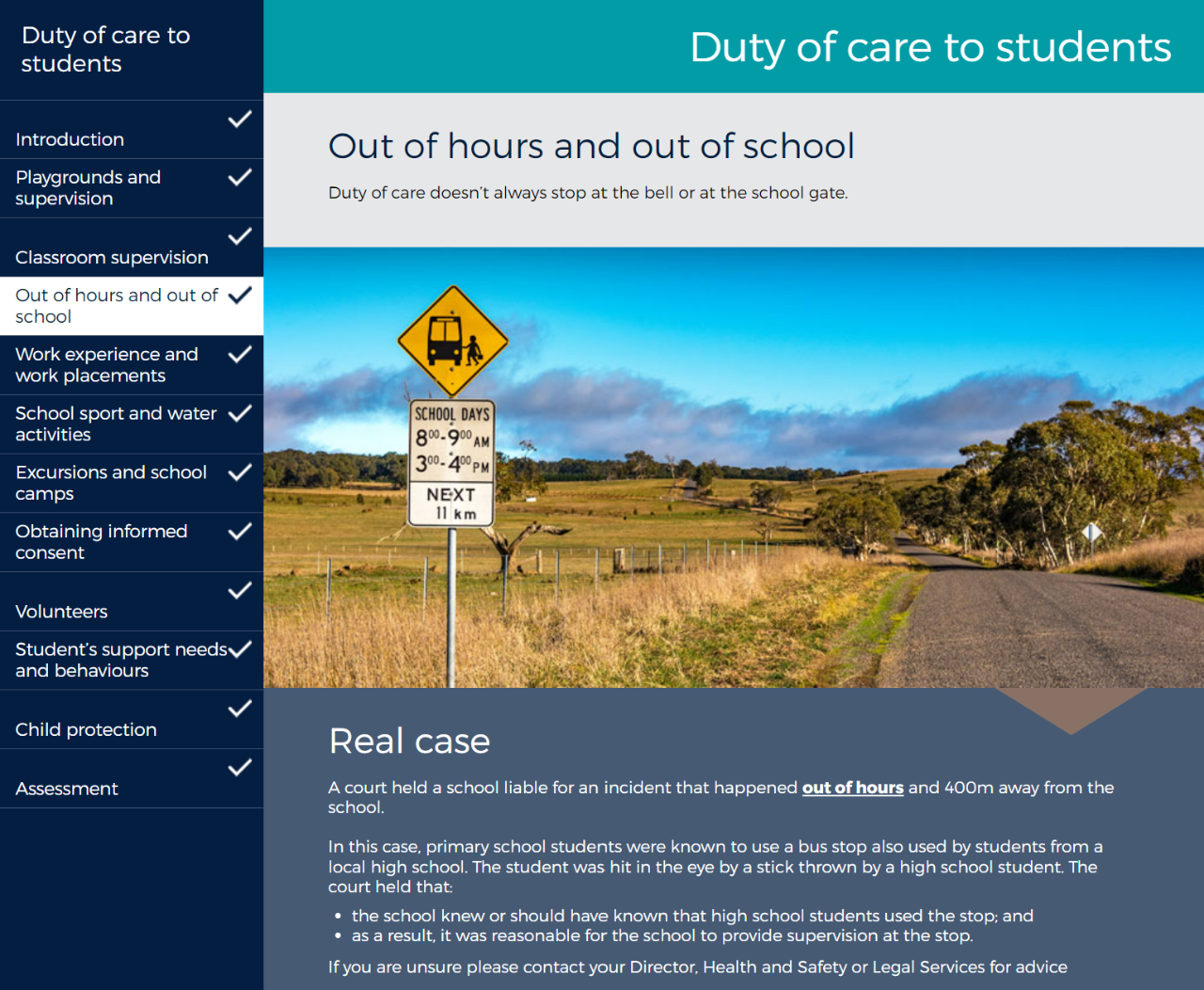
Duty of care doesn't stop at the bell or at the school gate.
It can extend outside of school hours and off school premises in circumstances where there is a clear and close connection to the school, for example on excursions, student travel to and from school, students travelling to TAFE/VET courses or work experience during or outside of regular school hours.
Under the department's Code of Conduct, section 8.6. Duty of care all personnel have a legal obligation to take reasonable care to minimise the risk of foreseeable harm (physical and psychological) to others.
Department staff can read more on Legal Services (staff only) about:
Duty of care encompasses a wide range of matters including but not limited to:
- providing adequate supervision, training and instruction
- ensuring grounds, premises and equipment are safe for employees, students and the general public
- implementing strategies to prevent bullying in the workplace, school or college
- providing first aid commensurate with your level of training and experience, or seeking assistance from emergency service to aid an employee, student or community member who is injured or becomes sick in the workplace.
All employees share in the department’s responsibility and commitment to the safety, health and wellbeing of themselves and others in their workplace and must comply with relevant legislation.
A greater level of care is required for a person who is vulnerable because of their age, maturity, skill level, disability, health or personal circumstances.
Duty of care extends to protecting students from self-harm while in school and reporting on incidents out of school.
Risk management procedures
Take a risk management approach to health and safety by using the department's risk management procedures. Work Health and Safety Advisors are available to support principals and other workplace managers to provide advice.
For further assistance refer to Supporting resources to manage risk. eg Health, Safety and Staff Wellbeing fact sheets (staff only)
- Lithium-ion batteries - usage, storage and management (PDF 141KB)
- vehicle on school grounds (PDF 199KB)
- Reasonably Foreseeable Emergencies Summary (244KB)
To assist schools complete a risk assessment refer to Controlling the road safety risks onsite and in the school traffic environment (pdf 134KB) staff only
A process for managing a school's duty of care and road safety
Schools can use Managing a school's duty of care and road safety process below, to address local road safety concerns, starting at any point.
Download and share a copy of the process with staff Managing a school's duty of care and road safety (PDF 184KB)
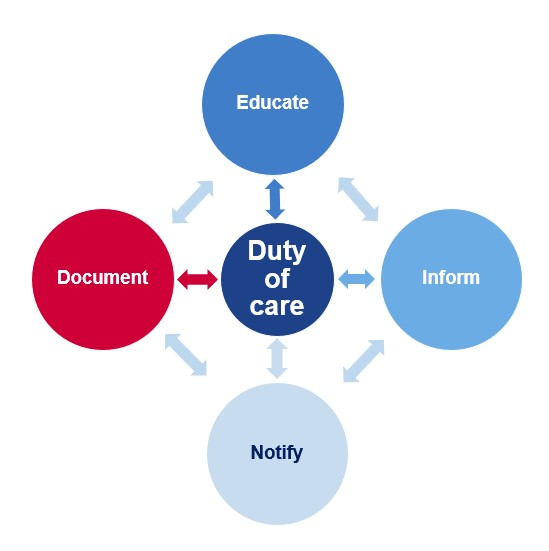
Which students need educating about the road safety concern?
- individual or small groups of students
- year/stage group of students
- the whole school?
How will road safety education be made relevant?
Through:
- localised, school-specific teaching and learning activities
- identified outcomes
- a strengths’ based approach?
Which parents/carers need informing about the road safety concern?
The parents of:
- individual or small groups of students
- a year/stage group of students
- all students?
How will it be communicated?
- e.g. social media (Facebook, school apps, Twitter)
- newsletters
- school website
- enrolment pack information,
- orientation day
- school noticeboard sign, email
- meetings
- take-home activity/note
If you need emergency services assistance call them before calling the WHS Incident Report and Support Hotline.
All department staff must report work health and safety (WHS) incidents, including injuries, hazards, and near misses, using the department’s approved reporting channels. : in line with Incident Notification & Response Procedures. This includes any non-workplace incident that impacts students, staff and the school community, e.g. travel to/from school.
Situations that have the potential to cause injury to an employee, student, member of the community, volunteer, or contractor should also be reported through the Mandatory incident reporting tools.
It is valuable to report all concerns to:
- highlight that a risk exists
- contribute to managing your duty of care
- get the concern noted so appropriate support and corrective actions can be initiated to prevent further incidents
- build a data profile that Health and Safety, and School Infrastructure NSW Directorates can use to bring about change for your school.
Who needs notifying if:
- student/s are unsafe road users
- the infrastructure is unsupportive to a safe school site or school zone
- Parents/carers
- Internally: school staff, P & C, school WHS Committee, WHS Advisor, WHS Incident Hotline, Assets Management Unit, local Director Educational Leadership, local Road Safety Education Officer
- Externally: Council Road Safety Officer or general manager, Transport for NSW, police highway patrol/liaison officer, council parking rangers, bus company, local businesses?
How can the notification be made?
e.g. phone call, face to face informal discussion/formal meeting, email, formal letters, Snap send solve app
Who will document, record and track the actions?
Reporting
- class teachers, SASS staff, school executive
Managing
- principal
How and where will the actions be documented, recorded and tracked?
Legal Services' advice
The department's Legal Services provides duty of care information in:
- Duty of care and behaviour management - About road safety (staff only)
- School leaders and the law (staff only) - an online professional learning module covering 8 key topics.
Topic 2. Duty of care to students addresses a school’s obligations for students and road safety in the out of hours and out of school section, as well as travel to and from a workplace program.
For more information, read further on our site about:
School Crossing Supervisor Program
Safe entry and exit of students
Advice for Principals to share with school community
Who can assist with road safety on and around schools?