
Guiding Principles in Leading Aboriginal Education
The purpose of the Guiding Principles in Leading Aboriginal Education
The Guiding Principles in Leading Aboriginal Education has been created to support the complexity and competing priorities within schools and the need for Aboriginal Education to have its footprints in the School Excellence Framework (SEF).
The document focuses on the expected observable practices of principals and school leaders who are committed to focusing on an Aboriginal educational perspective within the SEF’s Leading Domain. It encourages school leaders to self-assess their school’s status through an Aboriginal education perspective of the SEF and to also reflect on their professional capability to effectively lead Aboriginal education within their school community. Through leadership that is equitable, relational, and responsive, schools can drive positive changes in practices, school culture, and student outcomes, benefiting the entire school community.
By understanding the observable behaviours and key drivers for success in leading Aboriginal Education, school leaders can deepen relationships, foster meaningful connections, and reinforce shared responsibilities. These actions will enhance the credibility of schools and empower change, focusing on students' success.

Download the Guiding Principles in Leading Aboriginal Education
Implementation and impact
Review the document to build an understanding of the Key Drivers for Success.
Review the observable practices outlined in this document to foster a school environment where Aboriginal Education is a shared responsibility.
In partnership, confirm area/s for improvement.
Assess your school's standing within the SEF’s Leading Domain, focusing on collaborative leadership, cultural responsiveness, high expectations, place-based decision-making, and high-impact professional learning.
Develop and implement a plan for improvement.
Work with the community to create action plans, engage staff and students, and foster a school culture that prioritises Aboriginal education.
In partnership, reflect, embed and sustain.
Continuously monitor and adjust strategies using the Re-Imagining Evaluation Framework, centring the experiences of Aboriginal students, their families, and communities.
By using this document, school leaders can assess their practices, identify improvements, and implement strategies aligned with the key drivers for success in Aboriginal Education.
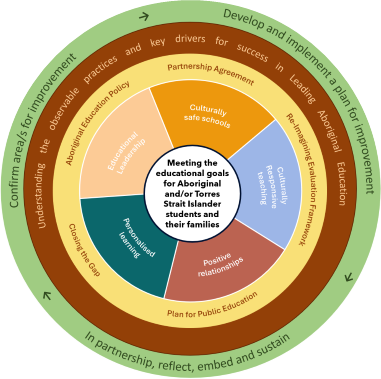
The SEF and Leading in Aboriginal Education
Principals and school leaders play a vital role in shaping school culture and improving educational outcomes for Aboriginal students. School leadership is instrumental in creating inclusive environments where every student can succeed.
This work aligns these themes with the Leading Domain of the School Excellence Framework. Key actions such as collaborative leadership, cultural responsiveness, high expectations, place-based decision-making, and localised, high-impact professional learning are crucial for ensuring schools excel in driving positive outcomes for Aboriginal students.
When school leaders embrace their pivotal role in fostering diversity and eliminating barriers, they create a more equitable educational landscape. Their leadership is key to ensuring Aboriginal students have the support they need to realise their aspirations.
School Reflection tool
This tool supports school leadership teams in reflecting on their progress and next steps in Leading Aboriginal Education. Aligned with the School Excellence Framework and guiding principles, it fosters meaningful reflection and continuous improvement to strengthen Aboriginal Education in schools across NSW.
Download School Reflection tool
Professional learning for schools
Aboriginal Education Learning Circles
Partnership, Planning, Practice
A strategic professional learning series for all educators committed to strengthening outcomes for Aboriginal and/or Torres Strait Islander students through authentic partnership, strong personalised planning and culturally responsive teaching.
Learning Circles kick off in Term 1 2026 focusing on Leading Aboriginal Education, with a new focus each term.
Illustrations of practice
The Leading Aboriginal Edication in Schools professional learning aims to support participants to strengthen their educational and instructional leadership in Aboriginal Education enabling sustained school wide culturally responsive systems, processes and learning environments to improve outcomes for Aboriginal and non-Aboriginal students.
Visit MyPL to find available sessions.
Narrator
The Aboriginal Education and Communities Directorate presents an illustration of practice from Singleton High School, showing how the school strengthens Aboriginal education by embedding the Guiding Principles in its leadership approach.
The Guiding Principles in Leading Aboriginal Education framework empowers school leaders to drive positive change through collaborative leadership, cultural responsiveness, high expectations, place-based decision making and high impact professional learning. It provides structure for self-reflection and action, opening connections with Aboriginal communities.
Leaders at Singleton High School foster an inclusive culture, and shared responsibility for Aboriginal education through personalised learning pathways. This enhances visibility, engagement, and collaboration, improving communication with families and keeping student goals at the forefront.
Liana Gill
We're a comprehensive high school. We are in a rural setting but we have about 912 kids and we have approximately 240 Aboriginal students and over a hundred staff.
Belinda James
The actual process itself we found really helpful because it was so structured. It was, it was hard to lose your way, so it kept us on track and at a pace that was realistic and where we needed to go.
There were quite a few data collection points at the outset towards the end and at different, after different PL opportunities that we had, and we were able to utilise that data to direct the work that we were doing, which was really good.
The staff that worked with us were sensational. They were so approachable when they came into the school to deliver.
Beay Berman
I had two roles in this. The first one was as a PLP mentor, but then I was also responsible for developing a folio in our learning management system where we could communicate with parents and upload work samples that were matched against the goals from the PLP.
Having teaching staff back involved in the PLP process is probably the biggest outcome in my staff room alone. Just the conversations around the students, their goals, their interests that are coming out of those PLP discussions.
I think because we had those regular PLPs that the training sessions, it was always the forefront of my mind as to where we were in the process, what we needed to develop next, and it just kept us very on track.
Zoe Allmark
I think for me it's the time to actually do it and the expertise training to be able to complete the PLP process. I'd never completed one before. I'd heard about them, but of course that was something that was done by the Aboriginal team, so for me it was just the confidence to actually complete the program, to actually complete the interviews and to also bring the academic rigor that us as teachers bring into the process.
It's also opened up conversations with the students that I'm a PLP mentor for, mentor for, and they feel like they can come to me and talk about not just the academic side, but also cultural significance as well, which has been a really important process.
Narrator
The professional learning is designed in three components, modelled on high impact professional learning. The Guiding Principles focuses on the expected, observable practices of principals and school leaders who are committed to focusing on Aboriginal education within the SEF'S leading domain.
In Component one, school leaders are encouraged to evaluate their school's performance in Aboriginal education. Using the Aboriginal perspective of the school excellence framework. They also reflect on their own abilities to effectively lead Aboriginal education in their school community.
In Component two teams work on a place-based action plan designed to meet the specific needs of their school. This phase lasts up to 10 weeks, allowing for targeted and strategic efforts.
In Component three, school leaders showcase and celebrate the accomplishments achieved during the process, emphasising the progress and positive impact of their work in strengthening Aboriginal education within their school.
Jo Vincent
The whole process has reinforced to me that we are on the right track. It is picked up some things along the way that we could have done better, and there's always things that you can do better. There's always room for improvement and, and it's really important for us to know what they are.
Peter Jackson
The most significant thing is a whole school shift, where it’s no longer one person or one team's responsibility. It is a responsibility of senior high school to meet the needs of the kids that come through our gates.
Narrator
Through leadership, that is equitable, relational and responsive, schools can drive positive changes in practice, school culture and student outcomes, benefiting the entire school community.
Reach out to your local Aboriginal Education team to further discuss this professional learning and other opportunities we offer.