
Implementation and evaluation
Effective implementation of Respectful Relationshsips Education (RRE) in schools requires a whole-school approach.
Components for whole-school implementation
A whole-school approach creates the most effective conditions for cultural change, consistently models respect and equality, and supports long-term positive outcomes for students, staff, and the wider school community.
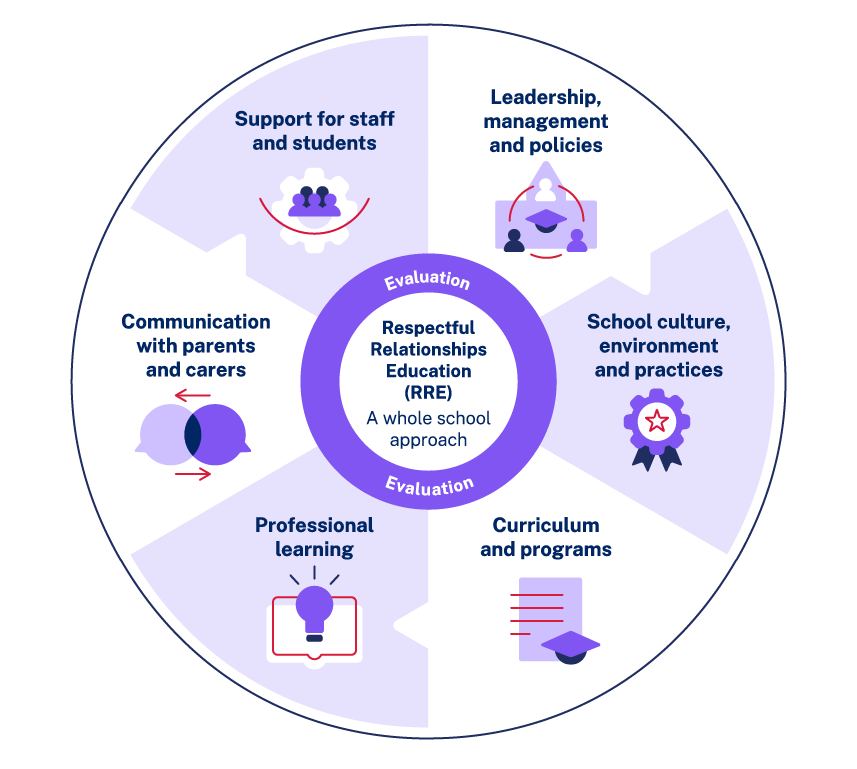
A whole-school approach to RRE embeds 6 components:
- leadership, management and policies
- school culture, environment and practices
- curriculum and programs
- professional learning
- communication with parents and carers
- support for staff and students.
Watch 'Six components for whole-school implementation' (7:34).
Speaker
There are 6 key components grounded in national evidence that support whole-school implementation of Respectful Relationships Education. While work in Respectful Relationships Education has been predominantly led through curriculum delivery in PDHPE, a whole-school approach builds on that foundation by involving all areas of the school community to create a more consistent and supportive environment for student learning and wellbeing. By engaging with all 6 components, schools foster a culture that models respectful behaviours and build student skills to navigate gender, power, consent, and digital safety.
In the slides that follow, we'll unpack each component using practical descriptions informed by the Our Watch Toolkit and aligned with New South Wales policy, curriculum and school planning structures. Leadership, management, and policies shape how Respectful Relationships Education is understood, prioritised, and embedded across a school. When leaders commit to a whole-school approach, they help ensure that learning about gender, power, consent, and safety as part of the school's culture, not confined to the curriculum. This includes supporting staff to plan and teach with confidence, modelling inclusive and respectful leadership, and aligning policies and planning so that the messages students receive are clear, consistent, and reinforced at every level. These actions demonstrate that respectful relationships are not an add-on. They are integral to how the school operates, teaches, and leads.
A school's culture and environment play a powerful role in how Respectful Relationships Education is experienced by students. When values like inclusion, fairness, and respect are modelled across everyday routines, interactions, and spaces, they reinforce what's being taught in the classroom. This might look like student-led initiatives that challenge stereotypes, consistent language around respectful behaviour, or visual cues that reflect the diversity and values of the school community. It also includes the way staff interact with one another, with parents and carers, and with students, modelling the kinds of relationships and interactions we want young people to build. When the environment supports the message, learning becomes more than a lesson. It becomes part of how students experience school.
Respectful Relationships Education is most powerful when it's embedded across the curriculum and supported by the wider school community. Teaching about topics like consent, coercion, help seeking, and digital safety requires more than just a single lesson. It needs structured, age-appropriate learning that builds over time. When these concepts are taught explicitly in safe and inclusive classrooms, students are more likely to develop the language, confidence, and strategies to navigate real-world relationships with respect and care. When this teaching is reinforced by the school's broader culture, policies, and partnerships, the learning is more likely to be sustained and have a lasting impact.
To teach Respectful Relationships Education well, staff need time to build knowledge, develop shared language, and reflect on how they approach sensitive topics, like gender, consent, coercion, and online safety. Professional learning helps teachers understand the content, plan with clarity, and respond safely when students raise difficult questions or disclosures. When teams plan collaboratively across classrooms and your levels, it strengthens consistency and builds a shared sense of purpose. This kind of collaboration, particularly around controversial or complex topics, also connects closely with broader school efforts to support staff and students. When schools create space for adults to deepen their knowledge and learn together, they're better equipped to create safe, consistent experiences for young people. When schools and families work together to reinforce shared values, students experience more consistent messages about respect, safety, and relationships, both at school and at home.
Open, purposeful communication helps families engage with key topics like consent, gender equality, and digital safety, and create space for meaningful conversations beyond the classroom. This might include co-designed communication plans, inclusive messaging in newsletters, or opportunities for carers to connect with what students are learning through Respectful Relationships Education. Clear, consistent, and inclusive communication builds trust with families, reinforces what students are learning, and helps create a school culture, where respectful relationships are supported by the whole community.
Finally, as schools engage with Respectful Relationships Education, it's essential they have clear coordinated systems in place to support both students and staff with lived or living experience of domestic, family, or sexual violence. This support might include well-defined referral pathways, strong connections with external services, and clear internal processes that are consistently understood and applied. It also means creating a professional culture where accessing support is safe and free from stigma, where both students and staff know that they will be listened to, respected, and supported. When these structures are embedded across the school, they build trust, strengthen staff capability, and ensure Respectful Relationships Education is delivered in an environment that prioritises safety, care, and shared responsibility. Our Watch, a national leader in the primary prevention of violence against women and their children has been instrumental in shaping this work. Their research and evidence base has been foundational in developing the New South Wales Respectful Relationships Education program and implementation model. By adopting a whole-school approach, schools create a climate where respect is not only taught; it's modelled, expected, and lived every day by everyone.
[End of transcript]
Implementation resources
To help schools implement RRE, a range of resources have been developed and aligned to the School Excellence Framework (SEF) and existing processes as part of the School Excellence cycle. This supports schools to leverage off existing programs and initiatives to embed RRE into their school, rather than view it as an add on.
The RRE Program also provides models and examples of RRE practice in schools to show how RRE can be implemented and embedded in different school contexts.
These resources support across the phases of RRE implementation and evaluation.
Each year of implementation, schools should:
- identify two focus areas for action from the six components of a RRE whole-school approach (PDF 266 KB)
- establish an implementation team and maintain it to lead RRE implementation
- use the self assessment tools
- create a school implementation or action plan
- build staff capability through access to RRE professional learning and resources
- track and monitor progress of RRE programs and actions as part of a whole-school approach to RRE.
Last modified date
07/05/2026
Business unit contact email
Executive director
Megan Kelly
Executive director’s business unit
Teaching Learning&Student Wellbeing