
Earth and Environmental Science Life Skills 11–12 Syllabus (2025) – information for school leaders
Learn about the Earth and Environmental Science Life Skills 11–12 Syllabus (2025) – what has changed and where to get further support.
The Earth and Environmental Science Life Skills 11–12 Syllabus (2025) replaces content in the Earth and Space Science Life Skills Stage 6 Syllabus (2017). Planning and preparation will commence in 2025, with implementation scheduled for 2028.
The Earth and Environmental Science Life Skills 11–12 Syllabus (2025) recognises the critical importance of exploring Earth’s systems, the environment, and the interactions between people and the planet. It aims to develop students’ understanding and appreciation of the dynamic interrelationships between Earth’s systems and human activity. It enables students to apply the working scientifically skills and the scientific method to their understanding of the environment, sustainability, and the structural, geological, atmospheric and human processes that affect the Earth.
What you need to know
- The Earth and Environmental Science Life Skills 11–12 Syllabus (2025) is a live document, available via the digital platform on the NSW Curriculum website. Teacher advice and support materials will be continually added throughout the implementation process.
- The NSW Department of Education will be providing support materials to schools to assist and guide the implementation process.
- NSW syllabuses accommodate teaching approaches that support student diversity.
- 2025–2027
- Engage, plan and prepare to teach the new syllabus.
- 2028, Term 1
- Start teaching the Year 11 course of the Earth and Environmental Science Life Skills 11–12 Syllabus (2025) to Year 11 students.
- Continue teaching the Earth and Space Science Life Skills Stage 6 Syllabus (2017) HSC course to Year 12 students.
- 2028, Term 4
- Start teaching the Year 12 course of the Earth and Environmental Science Life Skills 11-12 Syllabus (2025) to Year 12 students.
The Earth and Environmental Science Life Skills 11–12 Syllabus (2025):
- has been streamlined and peripheral content removed, allowing for a restructure to include seven (7) focus areas, three (3) in Year 11 and four (4) in Year 12
- includes clearly defined content that improves student access to rich learning opportunities at school and pathways after school
- offers increased opportunities to apply scientific concepts and ideas to real-world situations
- includes assessable, specified scientific investigations that provide accessible opportunities for the development of knowledge, understanding and skills
- includes Aboriginal and Torres Strait Islander Peoples’ content that provides all students with opportunities to explore Aboriginal and Torres Strait Islander Peoples’ Knowledges and Cultures
- Life Skills outcomes have been mapped to the Earth and Environmental Science 11–12 Syllabus (2025) outcomes to facilitate integrated delivery.
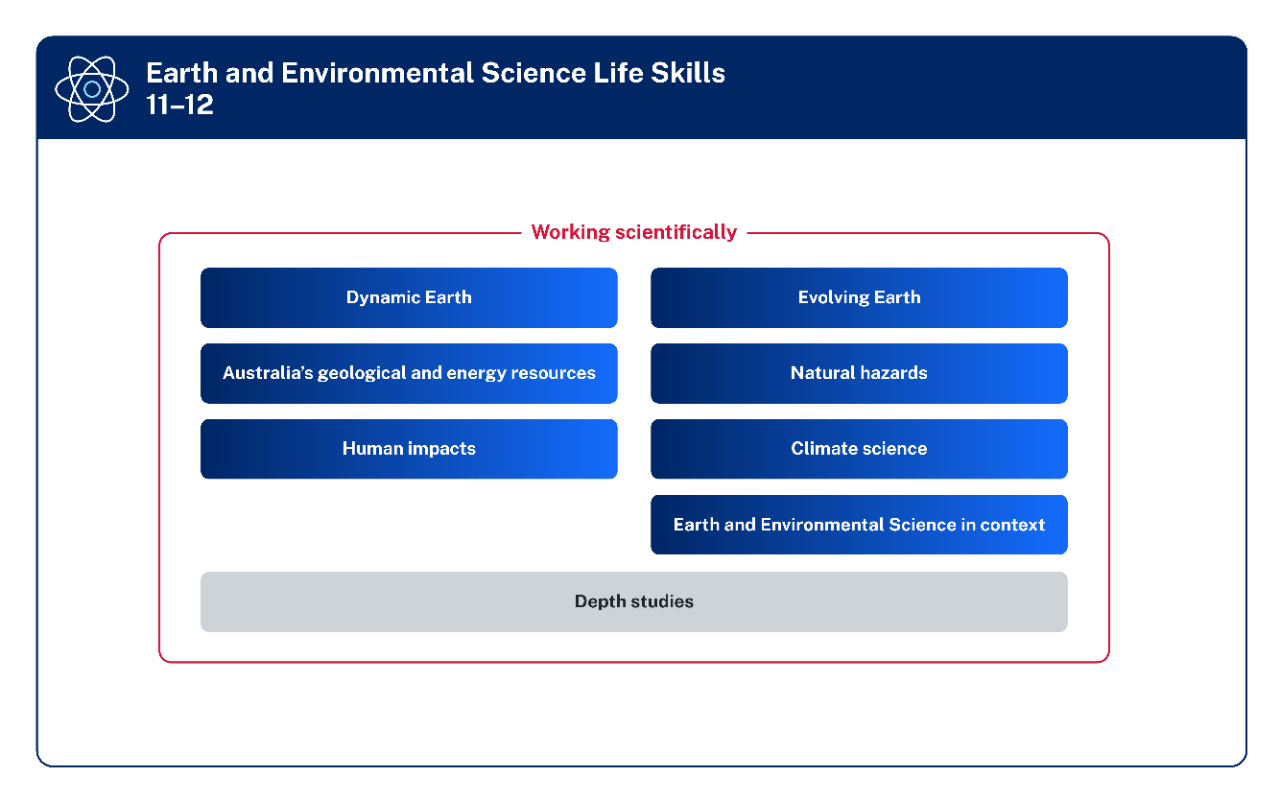
Earth and Environmental Science Life Skills 11–12 Syllabus © NSW Education Standards Authority (NESA) for and on behalf of the Crown in right of the State of New South Wales, 2025.
Before implementing the Earth and Environmental Science Life Skills 11–12 Syllabus (2025), leaders will need to consider the following:
- complexities arising for staff working across 2 Earth and Environmental Science syllabuses as they will teach different courses to their Year 11 and Year 12 cohorts. It also coincides with the implementation of the Chemical World Science Life Skills 11-12 Syllabus (2025)
- building teacher understanding about working with Aboriginal and Torres Strait Islander content when designing and delivering content and assessment
- supporting teachers’ understanding of the principles of inclusive education, adjustments and access to the Earth and Environmental Science Life Skills 11–12 Syllabus (2025) for learners
- resource and budget implications, including:
- providing time for staff to engage with the expectations of the Earth and Environmental Science Life Skills 11–12 Syllabus (2025), especially the novel content contained in it, so that they are best prepared to teach the course in 2027
- determining what resources are currently available to address new course requirements, including practical investigations and purchasing equipment and additional resources to address areas of need
- all decisions about curriculum options for students with disability should be made through the collaborative curriculum planning process
- leaders will need to consider the eligibility of students for a Life Skills pattern of study.
The syllabus for Earth and Environmental Science Life Skills 11–12 is based on evidence summarised in the bibliography published by NESA. The evidence base highlights that:
- students need to make connections across scientific concepts that facilitate the application of knowledge to new scenarios (Bravo González and Reiss 2021; Harlen et al. 2015)
- although built on prior knowledge and understanding, the learning of new abstract concepts is aided by the multisensory input inherent in modelling and practical experiences (Essex, 2018)
- student performance at multiple levels of sophistication is supported by a learning progression framework that identifies and fuses core disciplinary ideas and scientific practices (Corcoran et al., 2009; Gotwals & Songer, 2013)
- the syllabus should be knowledge-rich, as disciplinary knowledge is liberating and enables students to make sense of the physical world (Young, 2014)
- the syllabus should distil scientific knowledge into big ideas and guiding principles for students to be able to explain and make sense of a diversity of physical phenomena (Harlen et al., 2010).
Earth and Environmental Science Life Skills 11–12 Syllabus © NSW Education Standards Authority (NESA) for and on behalf of the Crown in right of the State of New South Wales, 2025.
- How will the new syllabus affect classroom practice? What measures are in place to support and evaluate this practice?
- What school practices and systems are in place to support teacher professional learning? How are these evaluated to maximise support for teachers?
- To what extent are staff ready to undertake syllabus implementation? How is that readiness determined?
- How has the school engaged with departmental resources and support for curriculum implementation, such as Curriculum networks, curriculum resources, professional learning, and DEL network initiatives?
- What enablers and barriers to successful curriculum implementation have been identified? What plans are in place to overcome the barriers and leverage the enablers?
- NSW Department of Education Planning, programming and assessing science 11–12
- NSW Department of Education Professional learning science K–12
- NSW Department of Education Science 11–12 curriculum resources
- NESA Earth and Environmental Science Life Skills 11–12 syllabus
- NESA Earth and Environmental Science – Teaching and Learning Support
Further support
- See Leading curriculum K–12 for updates and additional information
- Science K–12
- Contact the science curriculum team: science7-12@det.nsw.edu.au
- Join the Science NSW Statewide Staffroom