
Dance Life Skills 11–12 Syllabus (2025) – information for school leaders
Learn about the Dance Life Skills 11–12 Syllabus (2025) – what has changed and where to get further support.
The Dance Life Skills 11–12 Syllabus (2025) replaces content in the Dance Life Skills Stage 6 Syllabus (2009). Planning and preparation will commence from August 2025, with implementation in 2027.
The Dance Life Skills 11–12 Syllabus (2025) provides opportunities for students to engage with dance works and develop knowledge and skills in the performance, choreography and appreciation of dance, enabling students to communicate through dance and collaborate with others in a range of contexts.
What you need to know
- The syllabus is a live document, available via a digital platform on the NESA website. Teacher advice and support materials will continue to be added throughout the implementation process.
- The NSW Department of Education will be providing support materials to schools to assist and guide the implementation process.
- NSW syllabuses accommodate teaching approaches that support student diversity.
- 2025–2026
- Engage, plan and prepare to teach the new syllabus.
- 2027, Term 1
- Start teaching the new syllabus for Year 11.
- Continue to teach the Dance Life Skills Syllabus Stage 6 (2009) for Year 12.
- 2027, Term 4
- Start teaching the new HSC course for Year 12.
The Dance Life Skills 11–12 Syllabus (2025) includes:
- changes in the organisation of the focus areas and the content groups
- content is structured under focus areas that align with the Dance 11–12 Syllabus (2025) rather than by objectives
- ‘Choreography’ has replaced ‘Composition’ as the title of the focus area. ‘Structure’ is a new content group relative to Performance, Choreography and Appreciation
- components of performance, choreography, and appreciation are a new content group relative to the new focus areas of Performance: Dance work, Choreography: Dance work and Appreciation: Dance work
- increase in outcomes allows for greater flexibility for student needs
- inclusion of Protocols for collaborating with Aboriginal and Torres Strait Islander Communities and engaging with Cultural works
- Life Skills outcomes have been mapped to the Dance 11–12 Syllabus (2025) outcomes to facilitate integrated delivery.
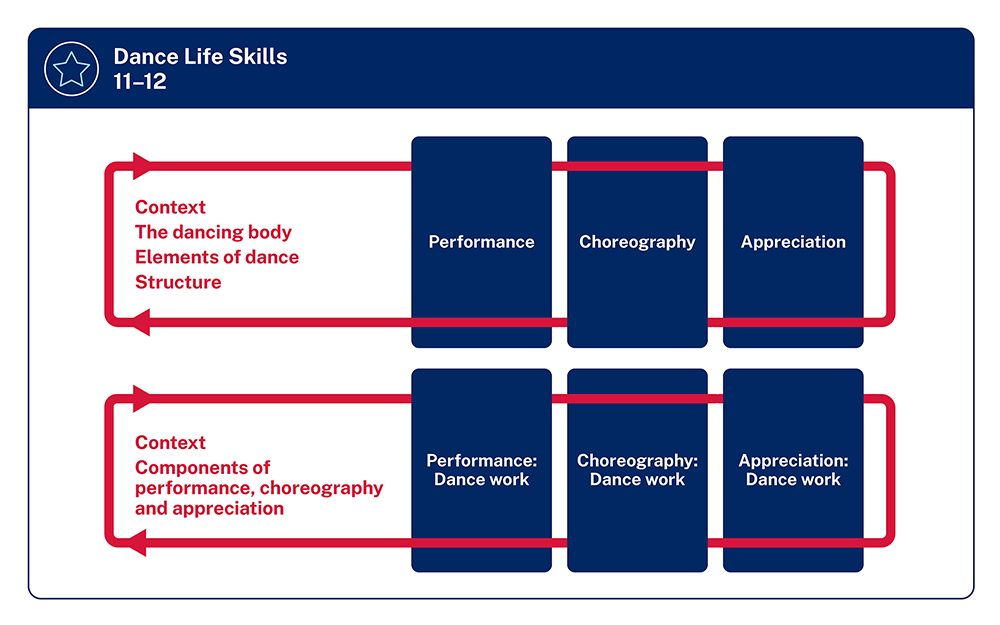
The organisation of the outcomes and content for Dance Life Skills 11–12 Syllabus (2025) © NSW Education Standards Authority (NESA) for and on behalf of the Crown in right of the State of New South Wales, 2025.
Prior to implementing the Dance Life Skills 11–12 Syllabus (2025), leaders will need to consider the following:
- The complexities for staff working across 2 syllabuses to teach Dance Life Skills 11–12 and the complications of a staggered implementation structure (Syllabus differences include structure, language, outcomes and content).
- The implications of multiple syllabus release dates across the subjects within creative arts and implementation structures staggered across multiple cohorts and subjects.
- Building teacher understanding about working with Aboriginal and Torres Strait Islander content when designing and delivering dance content and assessment.
- Supporting teachers’ understanding of the principles of inclusive education, adjustments and access to the dance curriculum for all learners.
- Resource and budget implications, including
- providing time for staff to engage with syllabus expectations and build their skills and understanding to effectively teach and plan the syllabus
- determining what resources are currently available and purchasing additional resources to address areas of need
- equipment that enhances learning and supports all students to access the curriculum such as screen readers, audio-visual material and other inclusive learning tools.
- All decisions about curriculum options for students with disability should be made through the collaborative curriculum planning process.
- Suitability of a Life Skills pattern of study for students. Leaders will need to consider the eligibility of students for a Life Skills pattern of study.
The syllabus for Dance Life Skills 11–12 is based on evidence summarised in the bibliography published by NESA. The evidence base highlights:
- 'Dance is an engaging art form that fosters intrapersonal, interpersonal, and intellectual competencies … Within dance, students are provided opportunities that foster communication, collaboration, creative problem-solving, and critical thinking skills. Research and practice show that dance experiences enhance children’s social-emotional development.' (Brouillette 2009:168).
- The National Advocates for Arts Education (NAAE) has found that engaging young people in arts-rich education programs leads to benefits such as improved literacy and numeracy skills, enhanced higher-order thinking abilities, greater motivation to learn, and effective social behaviour. (NAAE 2017).
- Participating in Aboriginal and/or Torres Strait Islander performing arts allows students to explore the rich and diverse Histories and Cultures of these Communities, deepening their awareness and understanding of the world. '...dancers often use subtle yet stylised symbolic movement to support the telling of stories, including those carried through Songlines -traditional musical narratives which serve as an Aboriginal ‘voice map’ of Country, conveying important journeys made during the Dreaming. In this way, and akin to traditional belief systems, dance customs have tended to embrace an intricate human, geographic and spiritual interrelationship.' (Narragunnawali Resource Guide n.d.:2).
- Through creative, respectful, and collaborative interactions, students can develop knowledge and intercultural understanding, appreciating their own identity as well as the beliefs, cultures, genders, and ethnic backgrounds of others. These experiences encourage the celebration of cultural diversity and allow students to share their heritage through a shared artistic language in a supportive environment. Such learning opportunities can break down barriers and foster stronger, more connected communities. (California Department of Education 2021).
- Dance, including inclusive dance, offers benefits for all participants. It creates opportunities to form meaningful relationships, enhances verbal and motor skills, and provides a meaningful outlet for self-expression and enjoyment. (Po 2020).
Dance Life Skills 11–12 Syllabus (2025) © NSW Education Standards Authority (NESA) for and on behalf of the Crown in right of the State of New South Wales, 2025.
- To what extend do staff understand the syllabus changes and have familiarised themselves with the new syllabus?
- To what extent do staff understand how the changes to the syllabus focus areas and content groups will impact their programming?
- How have change management considerations been embedded into the School Excellence Plan (SEP) to support teachers and sustain and strengthen curriculum implementation?
- What structures are in place for tailored professional support for all staff to strengthen curriculum implementation? What else might be required for this syllabus?
- What resources are required to commence syllabus implementation and meet planning, programming, assessing, and reporting requirements?
- How has the school engaged with departmental resources and support for curriculum implementation, for example, Curriculum networks, curriculum resources, professional learning, and DEL network initiatives?
- Dance Life Skills 11–12 Syllabus (2025)
- See NSW Department of Education Curriculum Reform for updates and additional information.
- Creative arts K–12 curriculum
- Join the creative arts curriculum support team in our statewide staffroom
- Email: creativearts7-12@det.nsw.edu.au
Further support
See Leading curriculum K–12 for updates and additional information.