
Dance 11–12 Syllabus (2025) – information for school leaders
Learn about the Dance 11–12 Syllabus (2025) – what has changed and where to get further support.
The Dance 11–12 Syllabus (2025) replaces content in the Dance Stage 6 Syllabus (2009). Planning and preparation will commence from August 2025 with implementation in 2027.
The Dance 11–12 Syllabus (2025) recognises the critical importance of the key Dance practices of performance, choreography and appreciation, which form the Focus areas. In the Year 11 course, the emphasis is on the discrete and explicit study of the focus areas. In the Year 12 course, students synthesise their knowledge, understanding and skills both in and across the focus areas.
What you need to know
- The syllabus is a live document, available via a digital platform on the NESA website. Teacher advice and support materials will continue to be added throughout the implementation process.
- The NSW Department of Education will be providing support materials to schools to assist and guide the implementation process.
- NSW syllabuses accommodate teaching approaches that support student diversity.
- 2025–2026
- Engage, plan and prepare to teach the new syllabus.
- 2027, Term 1
- Start teaching the new syllabus for Year 11 and implementing new Year 11 school-based assessment requirements.
- Continue to teach the Dance Stage 6 Syllabus (2009) for Year 12.
- 2027, Term 4
- Start teaching the HSC course for Year 12 and implement new HSC school-based assessment requirements.
- 2028
- First Higher School Certificate (HSC) examination for the new syllabus.
The Dance 11–12 Syllabus (2025) includes:
- changes in the organisation of the focus areas and the content groups
- 'Choreography' has replaced 'Composition' as the title of the focus area
- Structure is a new content group in Year 11
- Components of performance, choreography and appreciation is new in Year 12
- the focus areas have equal indicative hours in Year 11 and Year 12
- Performance – 40 hours
- Choreography – 40 hours
- Appreciation – 40 hours
- changes to the school-based assessment weightings for Year 11 and Year 12
- Performance 35%
- Choreography 35%
- Appreciation 30%
- reduced outcomes in both Year 11 and Year 12
- inclusion of Protocols for collaborating with Aboriginal and Torres Strait Islander Communities and engaging with Cultural works
- changes in the course requirements and HSC examinations
- In Year 11 Appreciation students are to study an Aboriginal and/or Torres Strait Islander dance work and a work by an international choreographer.
- In Year 12 Performance, students will perform two contrasting dance works and participate in a structured interview.
- In Year 12 Choreography, students will draw on their research of a prescribed practitioner as stimulus for their choreographed solo dance work and participate in a structured interview. The choreographed dance work may be performed by the student themselves or another student at the school. Simple props and costumes that are integral to the Choreography are permitted.
- In Year 12 Appreciation, students will study the prescribed dance work from the HSC Dance prescriptions and will research one prescribed practitioner from the HSC Dance prescriptions.
- changes to the Dance HSC examination specification include
- Performance practical examination – 35 marks
- Choreography practical examination – 35 marks
- Appreciation written examination – 30 marks
- removal of the Major Study component in Year 12
- Life Skills outcomes have been mapped to the Dance 11–12 Syllabus (2025) outcomes to facilitate integrated delivery.
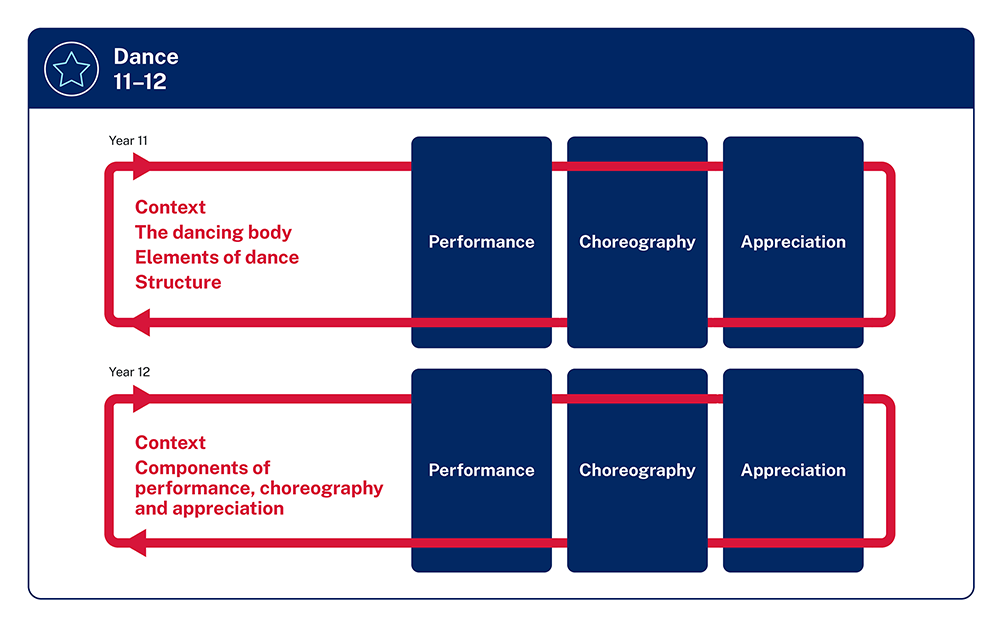
The organisation of the outcomes and content for Dance 11–12 Syllabus (2025) © NSW Education Standards Authority (NESA) for and on behalf of the Crown in right of the State of New South Wales, 2025.
Prior to implementing the Dance 11–12 Syllabus (2025), leaders will need to consider the following:
- the complexities for staff working across 2 syllabuses to teach dance 11–12 and the complications of a staggered implementation structure (syllabus differences include structure, language, outcomes and content)
- the implications of multiple syllabus release dates across the subjects within creative arts and implementation structures staggered across multiple cohorts and subjects
- building teacher understanding about working with Aboriginal and Torres Strait Islander content when designing and delivering dance content and assessment
- developing school processes and systems for effective task design and valid assessment of reduced outcomes (12 outcomes in Year 11 and 9 outcomes in Year 12)
- supporting teachers’ understanding of the principles of inclusive education, adjustments and access to the dance curriculum for all learners
- resource and budget implications, including
- providing time for staff to engage with syllabus expectations and build their skills and understanding to effectively teach and plan for syllabus requirements across 11–12 to implement in 2027
- determining what resources are currently available to address new course requirements and purchasing additional resources to address areas of need
- equipment that enhances learning and supports all students to access the curriculum such as screen readers, audio-visual material and other inclusive learning tools
- all decisions about curriculum options for students with disability should be made through the collaborative curriculum planning process
- suitability of a Life Skills pattern of study for students. Leaders will need to consider the eligibility of students for a Life Skills pattern of study.
The Dance 11–12 Syllabus (2025) is based on evidence summarised in the bibliography published by NESA. The evidence base highlights that the study of dance:
- is founded on concepts related to art, and artistic and aesthetic learning. (Abbs 2010; Bannon and Sanderson 2000; Best 1985; Brinson 1991; Carr 1999; McFee 1992, 1999; Reid 1989; Osborne 1970; Smith-Autard 2002; Stevens 1992)
- is 'a discipline that consists of combinations of dance techniques, practices, and principles from the sciences, education and somatics ... and values creative process, subjective experience, and reflective practice'. Dragon (2015:30)
- includes 'dance technique … to physiologically train the body to become stronger, more physically able and more proficient'. Rafferty and Stanton (2017:194)
- includes exploration of various types of stimuli, aesthetics, the symbolic meaning of dance language and ways to manipulate movement ideas creatively and critically through choreography (Côté 2006:27, Arnold 2005:55)
- develops understanding and valuing the study of dance from a sociocultural context (Davies 2013:196) and as an expression of ideas (Davies 2013:196)
- develops skills to describe, explain and interpret the meaning of a work of art and critically appraising its worth (Arnold 2005:53).
Dance 11–12 Syllabus (2025) © NSW Education Standards Authority (NESA) for and on behalf of the Crown in right of the State of New South Wales, 2025.
- To what extend do staff understand the syllabus changes and have familiarised themselves with the new syllabus?
- To what extent do staff understand how the changes to the syllabus focus areas and prescriptions will impact their programming?
- How have change management considerations been embedded into the School Excellence Plan (SEP) to support teachers and sustain and strengthen curriculum implementation?
- What structures are in place for tailored professional support for all staff to strengthen curriculum implementation? What else might be required for this syllabus?
- What resources are required to commence syllabus implementation and meet planning, programming, assessing, and reporting requirements?
- How has the school engaged with departmental resources and support for curriculum implementation, for example, Curriculum networks, curriculum resources, professional learning, and DEL network initiatives?
- Dance 11–12 Syllabus (2025)
- See NSW Department of Education Curriculum Reform for updates and additional information.
- Creative arts K–12 curriculum
- Join the creative arts curriculum support team in our statewide staffroom
- Email: creativearts7-12@det.nsw.edu.au
Further support
See Leading curriculum K–12 for updates and additional information.