
Outcomes
Students are offered places based on their academic merit.

The following information is about:
- Selective high school placement for Year 7 entry
- Opportunity class placement for Year 5 entry.
For entry starting in Years 8 to 11, outcomes are released by individual schools between September to October each year. Please contact the schools you have applied to for more information. See Selective high schools – Years 8 to 11 applications.
When are placement outcomes available?
The Selective Education Team will send you a message when your outcome is available in your application dashboard. An email will also be sent to alert you to the message.
| Placement | For entry year | Date (expected) |
|---|---|---|
Selective high school outcomes |
Year 7 entry in 2027 |
Late August 2026 (TBC) |
Opportunity class outcomes |
Year 5 entry in 2027 | Late September 2026 (TBC) |
How to view your outcome in the application dashboard
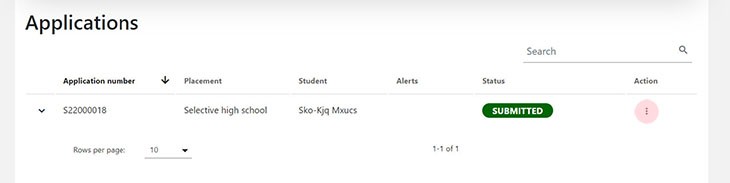
- Log in to the application dashboard (using the email and password you registered with).
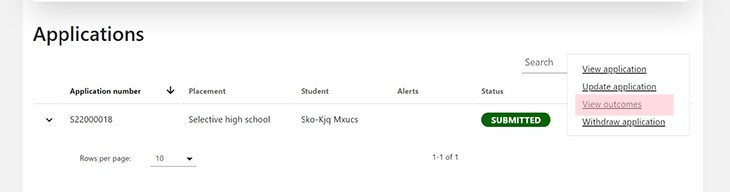
- Select the 3 dots under the 'Action' column
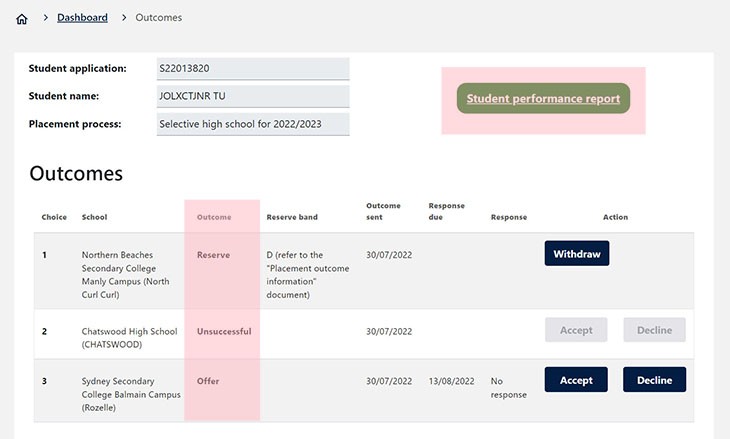
- Select 'View outcomes'.
- Select the 'Student performance report' button to see how your child performed on the test. See Performance report below for more information.
Having trouble logging in? Refer to 'Troubleshoot logging into the application dashboard' below.
How to log in
- Go to https://shsoc.education.nsw.gov.au and select ‘Log in’ from the lower section of the page.
- Enter your email address (that you used when registering for your online application).
- Enter your password.
- Select ‘Log in’.
- A confirmation code will be sent to your email address.
You may need to wait up to 10 minutes for the code to be received. The code is valid for 15 minutes. Check your Spam or Junk folders also. Please do not keep clicking on 'Resend confirmation code' otherwise your code will get out of sync. - Enter the code in the space provided and select ‘Confirm’.

Troubleshooting
Forgotten password
- If you have forgotten your password, select ‘Forgot your password’ to be sent an email to reset it (link is valid 2 hours).
If you experience difficulty re-setting a new password, ensure you have entered 14 characters which includes capital and uppercase letters, a number and a special character. - Check your Spam or Junk folder.
Wrong confirmation code
- If the wrong confirmation code is entered an error will appear. You will have 3 attempts to enter a valid confirmation code.
- You may also select ‘Resend confirmation code’ to receive a new confirmation code (via email) to enter.
- If you have entered 3 wrong codes, you will need to go back to the login page and re-start the log in process (each code will remain valid for 15 minutes).
Need more help?
If you still can’t log in please email: set@det.nsw.edu.au.
Outcomes – frequently asked questions
My child only got to sit the test once and did not receive a place. How is this fair?
Students are offered places based on their academic merit.
The decision to offer a re-sit test only to students impacted by the test environment on Friday 2 May was very carefully considered by the department as the fairest way to provide all students with the opportunity to do their best on the placement test.
An independent review into the fairness and integrity of the 2025 tests was undertaken by Professor Jim Tognolini, Director of the Centre for Educational Measurement and Assessment at the University of Sydney. Professor Tognolini found no evidence of systematic advantage for students who re-sat the test. You can read the report at Review of the fairness and integrity of the 2025 Selective High Schools and Opportunity Class Tests.
How is it fair that students re-sitting the test get to use their highest test performance?
This decision was very carefully considered by the department as the fairest way to provide all students with the opportunity to do their best on the placement test.
No student sat the same test twice. There were new tests to ensure fairness for all students.
The re-sitting of the tests and the use of the higher score for placement consideration is designed to provide students with an environment in which to demonstrate their academic potential.
Professor Tognolini’s review has found no systematic advantage for students who re-sat the test. You can read the report at Review of the fairness and integrity of the 2025 Selective High Schools and Opportunity Class Tests.
My child sat the test twice. Can you give me both scores?
Due to student wellbeing and privacy considerations, no test scores or placement ranks are provided to parents. The Performance report shows how your child performed in comparison to the other students who took the test that year.
My child sat the test twice. Which of the test results are included in their performance report?
The department compared the scores of students who took the test twice and the student’s highest score is their final score that forms the basis of the performance report.
Students who took the original tests were given a writing task and after this some coaching colleges gave students templates for writing. How is this fair?
No student sat the same test twice. There were new tests to ensure fairness for all students.
Students practise a wide range of text types at school. The writing component of the test is assessed based on the creativity and originality of the answer, as well as the ability of the students to communicate their ideas in written form. Our markers are highly trained and can easily identify memorised or template responses. Additionally, the move to computer-based testing means that the department’s ability to locate malpractice in the test has greatly improved.
Were there repeated questions in the tests?
The method used to link the different versions of the selective high school placement test (and opportunity class placement test) is widely used and includes the use of common items in the different versions of the tests. The methods used to compare the performance of students who have completed different versions of the same test are well-researched, implemented for almost all assessments, and are fair.
The same process is used to link different versions of the National Assessment Program – Literacy and Numeracy (NAPLAN) and several high stakes international tests (e.g., Programme for International Student Assessment (PISA) and Trends in International Mathematics and Science Study (TIMSS)).
The integrity and fairness of the tests has been independently validated by Professor Jim Tognolini, Director of the Centre for Educational Measurement and Assessment at the University of Sydney. Professor Tognolini examined whether students who sat the test twice as a result of the disruptions at the large centres had an advantage and whether all test versions were comparable and equally difficult. His review found that all test versions, including those used for re-sits, were of comparable difficulty, and where common questions were used between tests proven national and international methods were applied to ensure fairness across all sessions. You can read Professor Tognolini's report at Review of the fairness and integrity of the 2025 Selective High Schools and Opportunity Class Tests.
How can the department be sure that all of the tests were comparable?
There are measures in place to ensure there is no advantage from sitting the test on a particular day and performance can be compared across multiple test versions. All versions of the test are carefully calibrated to have the same degree of difficulty. The integrity and fairness of the tests has been validated by an independent university expert in assessment measurement which validated the methodology used to make sure all of the tests were comparable. You can read the report at Review of the fairness and integrity of the 2025 Selective High Schools and Opportunity Class Tests.
Was my illness/misadventure request accepted? How did this change my child’s score?
If your illness/misadventure request was approved and depending on your circumstances, your child may have received a score adjustment. Parents and carers will be advised of the illness/misadventure outcome and any adjustment will be accounted for in their placement outcome.
Please note due to student wellbeing and privacy considerations, no test scores or placement ranks are provided to parents.
Was my child’s score adjusted as a result of the technical issue they experienced?
Our placement test procedures include an illness/misadventure process where parent and carers of students who experience a technical issue during their test had the opportunity to submit an illness/misadventure request in their application dashboard for consideration of test performance impact.
We review all information included in illness/misadventure requests regarding test experience along with any incident reports for the test centre. Parents and carers are advised on the outcome of their illness/misadventure request when placement outcomes become available, including if an adjustment has been applied to their placement outcome.
Alternate academic merit – where student was unable to sit test and had an approved illness and misadventure request
Due to the postponement and rescheduling of some Opportunity Class and Selective High School tests in May 2025, the department acknowledges the unique circumstances faced by students who were unable to attend the rescheduled or make up test for valid reasons. Where a submitted illness and misadventure request was approved, alternate academic merit was considered for the placement of these students.
As in previous years, the department used NAPLAN results as an alternate form of academic merit for the placement test score. We use a statistical model developed by the department’s Centre for Educational Statistics and Evaluation to compare students who missed the test with those who sat it to estimate your child’s test performance.
Independent reports and reviews
Two reports about the 2025 placement tests are now available under reports and reviews on our website. This includes the Independent review of the 2025 Opportunity Class and Selective High School Placement Testing by Dr Michele Bruniges AM commissioned by the NSW Government into the delivery of the selective education placement tests, and an independent review into the fairness and integrity of the 2025 tests by Professor Jim Tognolini of the University of Sydney.
How offers work
Parents are offered a place based on test performance and the order of their school choices.
The test performance needed to get an offer at each school is different. This is because it is based on the number of students who apply, their test performance and the number of places available at the school.
When initial outcomes are released:
Parents can get a placement offer from only one school.
If your child’s test performance meets the levels needed for an offer from multiple schools, your offer will come from your higher choice school only. See Choosing schools – example scenarios.
Later offers from reserve lists
Students may be placed on a reserve list(s) for a higher-choice school(s) when outcomes are first released. If their position on the list is reached, they may get a later offer. Learn more below at What do the different outcomes mean?
What do the different outcomes mean?
You can have the following outcomes:
- Offer
- Reserve list only
- Offer and higher choice reserve list(s)
- Unsuccessful
- Not applicable.
Offer
Your child has been made an offer for placement at the school shown.
What you need to do now
- Decide whether to 'Accept' or 'Decline' the offer in the application dashboard by the 'Response due date'.
If you don't accept by the due date you will lose the offer.
You can accept now and decline later if you change your mind. But once you decline an offer you can't get it back again.
Reserve list only
This means you are on the reserve list (wait list) for this school.
You may get an offer later if your child’s reserve list position is reached before all vacancies are filled. For selective high schools you may get an offer up to the end of Term 1 of the entry year if vacancies occur. For Opportunity classes this may be up until the end of Term 1 in Year 6.
Students on reserve lists are not guaranteed an offer of a place. There is no reserve list for Aurora College.
Reserve band
In the outcomes page of your application dashboard a 'Reserve band ' (between band A to F) will also be shown.
This may help you get a sense of when you might get an offer. This is based on when students in a similar position on the reserve list were offered a place in the previous year.
Students who have an outcome of a 'reserve list' at newly established opportunity classes in 2026 have been equally distributed in the 5 reserve bands according to the way the students performed in the placement test. These new opportunity classes are at Doonside Public School and Guildford West Public School.
The bands are estimates only. There is no guarantee that you will receive an offer from a reserve list. Learn more at the relevant webpage below.
How do offers become available for students on a reserve list?
When a parent declines their offer at a school, the offer is then made to the next eligible student on the school’s reserve list.
What you need to do
- Check the Reserve list band showing in your child’s outcome for an estimate of when they might get an offer.
If you are already sure you don't want your child to be placed in the school showing 'Reserve' select 'Withdraw' in the application dashboard. Note: you cannot change your mind later if you withdraw from the reserve list.
What happens if your child's reserve list position is reached
The Selective Education Team will send you an email asking you to log in to your application dashboard to see your offer.
- You now need to decide whether to 'Accept' or 'Decline' your offer by the 'Response due date'. If you miss this date, you will lose the offer.
Offer and higher choice reserve list
You may get an offer and also be on a reserve list for a school of higher choice.
You may accept the offer and wait to see whether your child’s position on the reserve list for the higher choice is reached. You can keep the offer and the position on the reserve list until the 'reserve decision date' (see Key dates). After this date students holding accepted offers are removed from any higher choice reserve lists.
If you want your child to remain on a higher choice reserve list after this time, you must decline your accepted offer.
What you need to do
- Check the Reserve list band showing in your child’s outcome for an estimate of when they might get an offer (see Reserve band above).
- Keep or decline your accepted offer by the 'reserve decision date' – see Key dates.
If you are already sure you don't want your child to be placed in the school showing 'Reserve', select 'Withdraw' in the application dashboard. Note: you cannot change your mind later if you withdraw from the reserve list.
Enrolment
If you have accepted your offer, complete the school enrolment.
If you're later offered a place at your higher-choice school, you'll need to complete a new enrolment for that school. For more information see the School enrolment section below.
What happens if your child's reserve list position is reached
The Selective Education Team will send you an email asking you to log in to your application dashboard to see your new offer.
- You now need to choose to accept the new offer or decline it and keep your original offer. If you accept the new offer, the original offer is automatically declined.
Unsuccessful
Your child has been unsuccessful for placement for a chosen school.
If your child is unsuccessful for all of your choices, the individual schools will not be listed.
Not applicable
This means the school was a lower choice than another school that you have received an offer for.
You cannot get more than one offer when outcomes are first released. And you will always be offered the highest choice school for which your child qualified. This means your lower choice school is not applicable.
Performance report
When outcomes are released, you will also be able to view your child's Performance report for the placement test.
The report shows how your child performed in comparison to the other students who took the test that year.
For each of the test components, the report shows where your child performed in one of four bands:
- top 10% of candidates
- next 15% of candidates
- next 25% of candidates
- lowest 50% of candidates
The performance bands do not show the percentage of correct answers that your child achieved. Instead, the report shows how many other students performed within the same range.
The Performance report doesn't give individual test scores or placement ranks. Test scores or placement ranks are not available and cannot be provided (see Why can't I receive my child's test score below).
Download the relevant example Performance report.
Video – Understanding your child's performance report (duration 4:25)
Transcript of video animation: ‘Understanding your child's Performance report Transcript’ (4 minutes 25 seconds)
[music]
There are three test components that make up the opportunity class placement test. Reading, Mathematical Reasoning and Thinking Skills.
The Selective High School Placement Test is made up of four components: Reading, Mathematical Reasoning, Thinking Skills and Writing.
The Performance reports show how a child performed compared to the other students who sat the test.
The white box with the coloured icon shows a child's performance. For each component of the test, the students are placed in rank order. For example, if 15,000 students sat the Selective High School Placement Test roughly 1,500 students form the top 10% for each test component. The next 15% of students make up the top 25% of students. The next 25% of students make up the top 50% and the remaining 50% of students form the final 50% of students. In this example, that is 7,500 students.
It is important to understand that the Performance report does not show the percentage of correct answers a child has achieved for any of the test components.
For example, if a child is in the top 10% for Reading, this does not mean that they scored 90%. It means the child has achieved a result that places them in the top 10% of students who completed that reading test.
Likewise, a score in the lowest 50% for Thinking Skills does not mean a child failed that test component. It means the child's results place them in the lowest 50% of students that took the Thinking Skills test. In fact, for each test component, half of the students will be placed in the lower 50% and there is no pass or fail mark for any of the test components.
The placement tests are designed for one specific purpose. To identify students who will benefit from placement in an opportunity class or selective high school.
The questions do not measure knowledge of the school curriculum, but rather problem solving and critical thinking ability, and therefore cannot be used as a diagnostic tool to identify curriculum areas where children can improve.
For many children, the Opportunity Class Placement Test or the Selective High School Placement Test is one of their first formal testing experiences. Therefore, it is important to consider if and how you will share a child's results with them.
Many children who sit the tests are used to performing well academically, and they may be disappointed if they did not achieve similar results to those they achieve at school. If sharing the Performance report with a child, please emphasise that the test is not an indication of how well they are doing at school or how well they are doing in comparison to other students in their grade.
The questions on the test are designed to challenge gifted and high potential students who are already able to perform at the very top of their grade level. There is no pass or fail mark, and only about one in eight students are successful in gaining a place in an opportunity class and a quarter of students are successful in gaining a selective high school place.
Also, it is important to highlight what the child has achieved. Taking the test is an achievement in itself, and it can help to acknowledge and celebrate this.
For further information about the opportunity class and selective high school placement process, please visit our website.
[music fades]
[End of transcript]
Parents, students and schools have told us that past reporting of scores was impacting upon student privacy and wellbeing. For example, encouraging unhealthy competition between students.
Also, the placement tests are designed for one purpose – to identify students who will benefit from placement in a selective high school or opportunity class.
Your child's performance on the test cannot be used for any other purpose. The questions do not measure their knowledge of the school curriculum. So their performance cannot be used to judge how your child's learning is developing at school.
There are no set minimum entry scores to receive an offer to a selective high school or opportunity class.
This is because the level of test performance required for each school depends on:
- the number of students who apply
- their relative performance in the placement test
- the number of places available
- how many offers are declined by parents or carers (for offers from the reserve lists).
For help with deciding upon your school choices go to What to think about when choosing your schools.
School enrolment
To enrol in selective high school or opportunity class you must meet all NSW Department of Education enrolment conditions – learn more at Enrolment.
Selective high school – Year 7 entry
If you accept an offer, you will receive an email asking you to complete an online enrolment.
You need to complete the online enrolment within 2 weeks of receiving the email. For more information visit online enrolment.
You should also check the enrolment information on the school’s website. Your application to enrol will be finalised once you have met with the school and provided all the relevant identity and medical documentation.
If you accept a reserve offer from a higher choice school, you will receive a new enrolment email to complete within 2 weeks. Your previously accepted enrolment will be automatically cancelled.
Enrolment into a selective high school cannot be deferred.
If you need to delay your child’s attendance beyond the first day of the school year, you must discuss this with the principal of the selective high school (or message the Selective Education Team if there is a need to negotiate a delay during school holidays).
Opportunity class – Year 5 entry
If you accept an offer, the school will contact you about their enrolment procedures and their orientation days.
Enrolment into an opportunity class cannot be deferred.
If you need to delay your child’s attendance beyond the first day of the school year, you must discuss this with the principal of the school (or message the Selective Education Team if there is a need to negotiate a delay during school holidays) .
How are outcome decisions made?
Students are offered places based on their performance on the test.
Up to 20% of places at each school are held for:
- students from low socio-educational advantage backgrounds
- Aboriginal and/or Torres Strait Islander students
- students from rural and remote locations
- students with disability.
These students still receive offers based on their test performance according to the Equity Placement Model. This makes access fairer for these high potential students who experience educational disadvantage – see Fair access.
Selection committee decisions
Some outcome decisions need to be decided by the selection committee.
Their decisions are based on academic merit and are made using consistent selection criteria.
The selection committee reviews and decides on placement for students who:
- are outside the usual age or Year range
- need consideration under the Equity Placement Model
- other relevant factors brought to their attention.
Based on performance in the placement test and the above considerations, the selection committee determines students to be listed for offers and reserve places according to the number of vacancies at the chosen opportunity class or selective high school.
Appeals
In a limited number of circumstances, you may be eligible to submit an appeal.
Note:
- It is not possible to have any test questions remarked. All multiple-choice test questions are computer-marked and manual reliability checks are already carried out to ensure their accuracy. Each writing test response, in the Selective High School Placement test, is already marked by two different examiners.
- No appeal will result in your child's test score or placement rank being given. All available information about your child's test performance is within their Performance report.
Appeals frequently asked questions
My child did the test on 2 May at a large test centre and the re-sit test. Can I appeal the outcome?
My child did the test on 2 May at a large test centre and the re-sit test. Can I appeal the outcome?
In a limited number of cases, you may be eligible to submit an appeal. Refer to the information here in the appeals section.
My child did the test on 2 May at a large test centre and did not re-sit the test. Can I appeal the outcome?
As your child did not re-sit the test you cannot appeal due to the test centre environment before and after the test on 2 May.
In a limited number of cases, you may be eligible to submit an appeal. Refer to the information here in the appeals section.
Why can’t I appeal based on the situation on 2 May if my child didn’t re-sit the test?
The department advised parents that if they did not want their child to re-sit the test, then they could not appeal the placement decision based on the test centre environment before and after the test.
My child’s test was rescheduled to late May. Can I appeal the outcome?
In a limited number of cases, you may be eligible to submit an appeal. Refer to the information here in the appeals section.
What are valid grounds for appeal?
You can appeal against the outcome if something stopped you from submitting an illness/misadventure request by the deadline (see Key dates).
Appeals that have the greatest chance of being upheld are those where:
- you know what happened to prevent your child from doing his or her best or attending the test, and
- you have written evidence to support your case.
What is the process for appealing my outcome?
You submit an appeal online following the instructions on our website (see below).
- Log in to your application dashboard.
- Go to the ‘application’ section, select the 3 dots under the 'Action' column and then select ‘Start appeal’.
- Complete the form.
- Attach your supporting evidence that clearly supports all of your points in your appeal.
- Select 'Submit'.
For more detailed instructions see the Outcome appeals section below and the Guide to submitting an appeal.
After reviewing your appeal, we send you a message in the application dashboard to let you know whether or not your appeal will progress to the appeals panel for their consideration.
How is the outcome of my appeal determined?
After reviewing your appeal, we send you a message in the application dashboard to let you know whether or not your appeal will progress to the appeals panel for their consideration.
Appeals made on invalid grounds will be acknowledged and assessed but will not be passed on to the appeals panels.
If the appeal is based on valid grounds, the appeals panel will consider your appeal. The panel will include a selective high school principal or an opportunity class principal, and a Director, Educational Leadership as Chair.
Why wasn’t my appeal sent to the Appeals Panel?
Appeals made on invalid grounds will be acknowledged and assessed but will not be passed on to the appeals panels. Appeals where any available valid adjustment would not make a difference to the placement outcome will not be passed on to the appeals panel. For more information please refer to the Selective high schools and opportunity class placement procedures.
Outcome appeals
Outcome appeal
All decisions made by the selection committee and appeals panel are based on the way students are ranked by performance in the placement test, for placement in opportunity classes or selective high schools.
All valid appeals will be considered by an appeals panel. The panel will include two principals of a selective high school or school with an opportunity class, and a Director, Educational Leadership.
Appeals must be submitted by parents and carers through the application dashboard by the due date listed in the key dates (typically 5 business days after placement outcomes are released). No late appeals will be accepted.
Appeals must include relevant supporting documentary evidence. This may include:
- documentation from medical practitioners
- evidence of unforeseen circumstances
All relevant documentary evidence must be included with an appeal when it is submitted. Once submitted, appeals cannot be edited or updated. The Selective Education Team will not request additional evidence, and any evidence received outside of the appeal will not be considered.
Only valid appeals with sufficient supporting evidence will be referred to the appeals panel. Appeals where any available valid adjustment would not make a difference to the placement outcome will not be passed on to the appeals panel.
Appeal decisions are final.
Invalid grounds for appeal
Invalid grounds for appeal include:
- matters that should have, or already have been dealt with in an illness/misadventure request
- lack of knowledge about the option to submit an illness/misadventure request and/or lack of knowledge about the illness/misadventure process
- concern about changes to the selection processes or the use of computer-based testing
- misunderstanding of the placement process
- the student’s academic performance on the practice opportunity class or selective high school placement tests on the Selective Education team’s website or other measurements or reports, such as IQ score, NAPLAN results, International Competition and Assessments for Schools (ICAS) testing, school reports or certificates and scholarship or coaching college testing
- parent, carer or student disappointment at not receiving an offer or not being placed on a reserve list
- young age of the student, lack of test preparation, educational disadvantage and the perceived failure of the student to demonstrate their potential
- perceived advantage the student may gain from placement in an opportunity class or selective high school, including but not limited to, travel convenience, attendance with friends or siblings (including twins/triplets), or benefits to the family.
How to submit an appeal against your placement outcome
First, review information about appeals included on this webpage. If you believe you have valid reasons for appeal, proceed with these steps:
- Log in to your application dashboard.
- Go to the Application section, select the 3 dots under the Action column and then select Start appeal.
- Fill in the form (as per the next steps below)
- Answer Yes or No to your child sitting the test.
- Enter the Grounds for your appeal in detail in the space provided.
- Attach your supporting evidence that clearly supports all of your points in your appeal. A maximum of 3 documents can be provided. Note: no additional documents or information can be added to the appeal after it is submitted. Ensure you include all necessary information in this request and submit it before the appeal period ends. Refer to Key dates for more information.
- Select Submit appeal once you have completed all sections. You will be notified of the outcome of your appeal. Refer to Key dates for more information.
A message will show confirming your appeal has been submitted.

How to view or withdraw your appeal
You can view your appeal or withdraw your appeal by selecting the 3 dots in the Action column for your application from the homepage of your dashboard.

How are outcome appeals decided?
The appeals panel meets to consider and decide the outcome for all appeals.
The appeals panel includes a selective high school principal or an opportunity class principal and a Director, Educational Leadership.
After the appeals panel meets, parents will be told about their outcome – see Key dates.
Malpractice appeals
Malpractice appeals
Parents and carers can appeal against the result of their malpractice appeal.
A link to appeal this decision will be available in the malpractice letter sent to parents and carers. The appeal must be submitted by the due date noted in the letter.
