
Get ready for the Opportunity Class Placement Test
Learn all about the test, what happens on test day, and try the practice tests.
Are you a parent or carer?
Please visit the Selective high schools and opportunity classes – information for parents and carers to learn about the placement process and to apply.
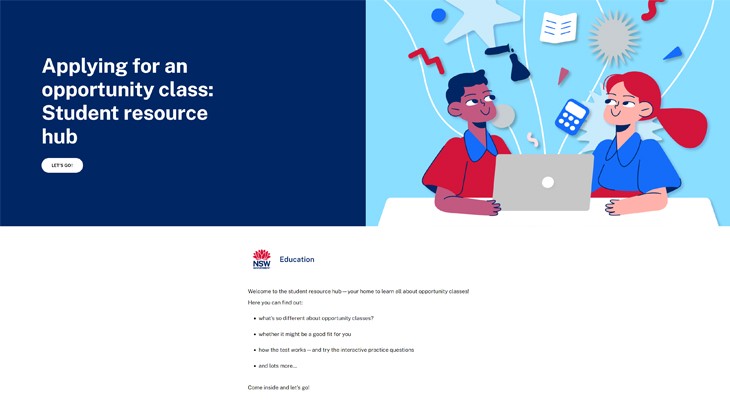
Student resource hub
Check out the Student resource hub where you can learn whether an opportunity class might be a good fit for you.
It also has:
- interactive quizzes
- practice test items
- and lots more to help you prepare.
What is in the test?
The Opportunity Class Placement Test has 3 test sections. The placement tests are computer-based tests.
| Test component | No. of questions | Time | Weighting |
|---|---|---|---|
| Reading Test | 14 (3 questions have multiple parts to answer) | 40 minutes | 33.3% |
| Mathematical Reasoning Test | 35 | 40 minutes | 33.3% |
| Thinking Skills Test | 30 | 30 minutes | 33.3% |
All questions are multiple-choice.
More about the 3 test parts
This part checks how well you understand different types of texts.
The texts are drawn from non-fiction, fiction, poetry and can include sections of novels or non-fiction books, poems, magazine articles and reports.
This part checks how well you use maths to answer a variety of questions.
You cannot use rulers or calculators in the test.
This part checks how well you can you solve a variety of problems.
Video – Opportunity Class Placement Test: a guide for students (duration 3:58)
[Transcript of video: ‘Opportunity Class Placement Test – a guide for students (3 minutes 58 seconds)]
This video about the Opportunity Class Placement Test will provide an overview of the test sections and types of questions used in the test.
The Opportunity Class Placement Test has been designed to allow you to demonstrate your reading, reasoning and thinking ability. This means that you do not need to learn or memorise facts about specific subjects. Instead you need to apply what you know to find the best answer.
There are three tests which are reading, mathematical reasoning and thinking skills. You will take the test one after another on a computer in a test centre. Most test centres will be a local high schools. You will read the questions and enter your answers on the computer. You cannot use a calculator, but we'll be able to do any working out on paper.
Let's take a look at each test.
For the reading test, you'll have 40 minutes to provide 33 answers across 14 questions. The questions are based on a diverse range of texts and assess a range of reading comprehension skills. You will read all texts on screen. Reading questions come in different contexts to test a range of skills. The questions are based on different genres and include non fiction and fiction such as poetry, magazine articles, reports and extracts from books. This is an example of a reading question. It is a multiple choice question assessing the reader's understanding of a poem. More reading example questions are available in the Practise tests on the website.
For the Mathematical Reasoning test you will have 40 minutes to answer 35 questions. The questions are all multiple choice with five possible answers. This tests mathematical reasoning skills and your ability to apply your mathematical understanding or knowledge to new problems. You can't use a calculator, but can use paper for working out. Questions can be drawn from a range of mathematical content areas. This is an example of a mathematical reasoning question. Select the best answer from the five options provided. More mathematical reasoning example questions are available in the Practise tests on the website.
For the Thinking Skills test, you'll have 30 minutes to answer 30 questions. The questions are all multiple choice with four possible answers. This test will assess your ability in critical thinking and problem solving. No previous knowledge is required. There are a range of different question types in the Thinking Skills Test. You can see them in the Practise Tests available on the website.
For further information and support, visit the Selective High Schools and Opportunity Classes website. For students, work through the activities in the Student Resource Hub and view the online practise tests. You can ask your parents to contact the selective education team by sending a message in the application dashboard if they have any questions.
[End of transcript]

Preparing for the test
Practice tests
You will feel more confident and prepared if you practise answering the below:
- online computer-based practice tests
- PDF copies of practice tests.
These are not the actual question you will get on the day, but examples of the types of questions you can expect.
Using the PDF copies of the practice tests you can view the questions, the answers and an explanation of the answers for the multiple-choice tests.
Online computer-based practice tests
PDF copies of the practice tests
Sample practice test 1
| Section | Links to samples | |
|---|---|---|
Reading |
Reading sample questions (PDF 1.4 MB) Reading sample answers (PDF 95 KB) Explanation of answers - Reading (PDF 2.6 MB) |
|
Mathematical Reasoning |
Mathematical reasoning sample questions (PDF 1.8 MB) Explanation of answers - Mathematical reasoning (PDF 3.6 MB) |
|
Thinking Skills |
Thinking skills sample questions (PDF 2 MB) Thinking skills sample answers (PDF 78 KB) Explanation of answers - Thinking skills (PDF 1.7 MB) |
Sample practice test 2
| Section | Links to samples | |
|---|---|---|
Reading |
Reading sample questions (PDF 1.6 MB) Reading sample answers (PDF 91 KB) Explanation of answers - Reading (PDF 2.8 MB) |
|
Mathematical Reasoning |
Mathematical reasoning sample questions (PDF 1.6 MB) Explanation of answers - Mathematical reasoning (PDF 3.3 MB) |
|
Thinking Skills |
Thinking skills sample questions (PDF 1.1 MB) Thinking skills sample answers (PDF 92 KB) Explanation of answers - Thinking skills (PDF 3 MB) |
Sample practice test 3
| Section | Links to samples | |
|---|---|---|
Reading |
Reading sample questions (PDF 1.6 MB) Reading sample answers (PDF 37 KB) Explanation of answers - Reading (PDF 2.9 MB) |
|
Mathematical Reasoning |
Mathematical reasoning sample questions (PDF 1.1 MB) Explanation of answers - Mathematical reasoning (PDF 3.3 MB) |
|
Thinking Skills |
Thinking skills sample questions (PDF 1.5 MB) Thinking skills sample answers (PDF 39 KB) Explanation of answers - Thinking skills (PDF 3 MB) |
I have a disability or a medical condition. Can I get help when sitting the test?
Yes. When your parents apply they tell us what adjustments you might need so you can sit the test.
Let your parents know that there is more information for them at Reasonable adjustments (see step 4 of 'Using the application website').
Test Day
Watch the video below so you are all ready to go on test day.
Video – What students can expect before, during and after the OC test (duration 5:06)
Test day checklist

All students need:
- two 2B pencils
- eraser
- pencil sharpener
- a printed copy of the Test admission ticket
- a clear bottle of water
- wear school uniform.
If required, bring:
- any items approved as adjustments for disability, e.g. FM transmitters
- EpiPen, asthma inhalers, diabetes or other medication
- glasses
- tissues
- a clear plastic bag for stationary (pencil cases are not allowed)
- a wristwatch (that cannot make a noise, calculate, compute, connect to the internet, send or receive messages, or facilitate attempted malpractice.)
Do NOT bring:
- pens
- rulers
- calculators
- note paper
- dictionaries or other books
- smart watches, phones or other devices that compute, photograph, communicate or make a noise
- pencil cases.
Download the Test day checklist for printing.

What happens next?
We will message your parents in late September to tell them if you have a place in an opportunity class.
And remember, whether you're in an opportunity class or not, all public schools in NSW will help you do your very best and reach your full potential.