
Methodology for the allocation of School Counselling Service
School Counselling Service allocation: 2026 - 2028
The allocation of the School Counselling Service has been guided by a state-wide methodology developed through consultation with stakeholders and supported by research.
Stakeholders included representatives from the Primary Principals’ Association, Secondary Principals’ Council, NSW Special Education Principals' and Leaders Association and PPA SSP reference groups. The new allocation cycle incorporates the planned 250 additional School Counselling Service positions.
What principles underpin the methodology?
The methodology for the School Counselling Service:
- is informed by current research, feedback from stakeholders and NSW school and student data
- provides every NSW public school a School Counselling Service allocation that reflects student need.
How is the allocation of School Counselling Service calculated?
From January 2026, the 2026 - 2028 School Counselling Service allocation will be implemented. The new model maintains the established provision of a minimum 1.0 FTE for high schools and for central schools with secondary enrolments of 200 or more students. The allocations methodology also accounts for additional allocation bands for very large schools.
The enrolment threshold for large schools (all settings) has been amended, lowering the requirement for a minimum 1.0 FTE from 850 students to 700 students as at the time of allocations being finalised.
For schools not captured above, schools with enrolments below 700, allocations will continue to be determined using the base methodology. This base methodology places a greater weighting placed on factors of need (60%) than enrolment numbers (40%). The socioeconomic disadvantage (FOEI), students impacted by disability (NCCD) and remoteness (ARIA+) factors of need contribute equal weightings of 20% each.
There are no changes to allocations for unique settings such as distance education schools, specialist hospital settings, or Intensive English Centres. Importantly, no school has received a reduced allocation under the revised model.
The flowchart below presents the process for calculating the School Counselling Service allocation, with explanatory notes under each step to guide understanding.
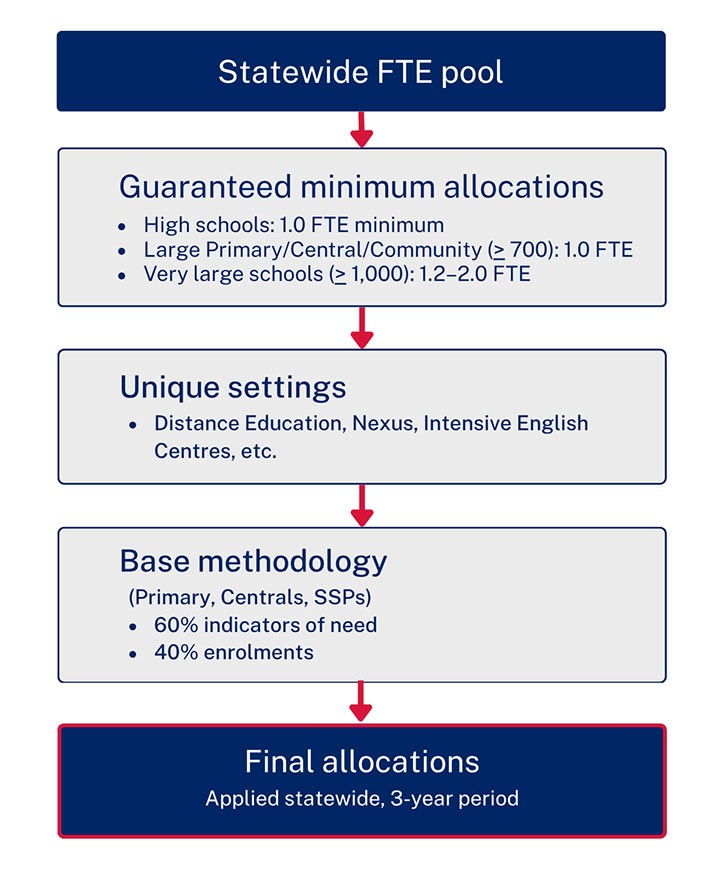
Allocation methodology application - step explanations
1. Statewide FTE Pool
The total number of full-time equivalent (FTE) School Counselling Service positions available across NSW public schools is treated as a single finite resource.
2. Minimum Allocations
- All high schools and central schools with secondary enrolments over 200 enrolments are allocated a minimum 1.0 FTE
- Large primary, central, or community schools with enrolments of 700 or more at the time of allocation were published receive a minimum 1.0 FTE.
- Very large primary, central or community schools with 1,000+ enrolments are allocated between 1.2 and 2.0 FTE, depending on enrolment size.
3. Unique Settings
Unique settings, including Intensive English Centres, and other targeted programs, are considered separately to reflect their unique student populations and support needs.
4. Base Methodology
For all remaining primary, central, and Schools for Specific Purposes (SSPs) with enrolments below 700, allocations are calculated using a weighted model:
- 60% based on factors of need – socioeconomic disadvantage (Family Occupation & Education Index), students impacted by disability (NCCD) and remoteness (ARIA+).
- 40% based on total enrolments preschool to year 12 as at the time of allocations being finalised (enrolments in support classes are counted as notional enrolments).
5. Final Allocations
Once all steps are applied, the final allocations are distributed across all schools statewide for the published allocation period.
How is the remoteness factor of need calculated?
The remoteness factor measures remoteness using Accessibility/Remoteness Index of Australia (ARIA+). ARIA+ is a measure of service accessibility and remoteness derived from road distances between populated localities and service centres. ARIA+ is widely used across Australia and has become recognised as a nationally consistent measure of geographic remoteness.
Contact information
Principals can contact their Senior Psychologist Education for information about School Counselling Service itineraries.
For further information including internal contact details, department staff can access Methodology for the allocation of School Counselling Service (staff-only)
Last modified date
23/07/2026
Business unit contact email
Executive director
Jacqueline Hodges, Silva Hiendra
Executive director’s business unit
Education and Skills Reform